
Buying a boat with lithium batteries: what should you check?
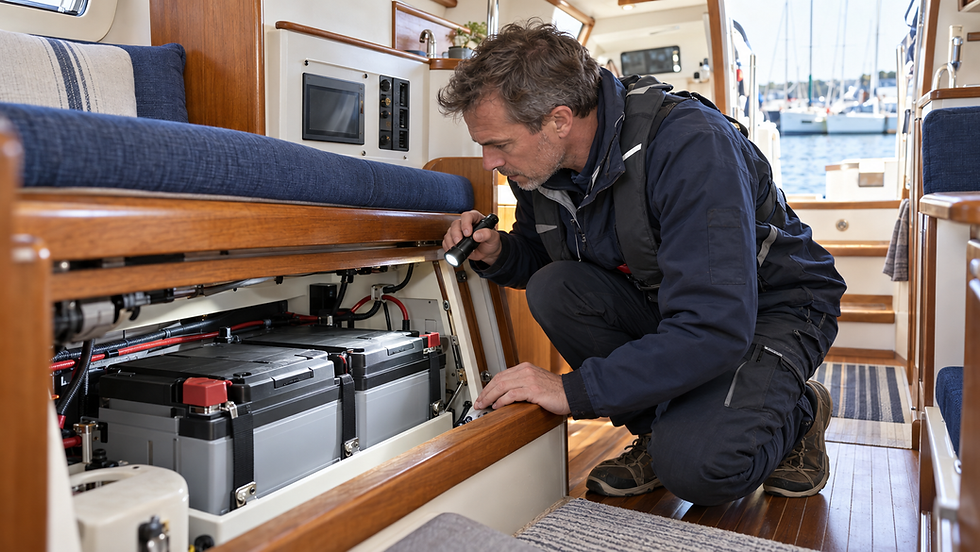
The sales particulars say “upgraded to lithium”. That may be welcome news to a buyer who wants more usable battery capacity. It should also begin a more precise conversation: what was fitted, who designed and installed it, how is it charged, and what has the insurer been told?
Lithium-ion systems are increasingly part of life afloat. In May 2026 the Boat Safety Scheme (BSS) updated its lithium-ion safety advice, which now covers small portable devices, large portable devices and installed battery systems. Its concern is not that every lithium battery is unsafe. It is that a failure can develop very quickly, and that a safe system depends on three things together: correct installation, appropriate charging and a robust battery management system (BMS).
Why a lithium failure is different
A lead acid battery that fails usually does so slowly. A lithium-ion cell that is overcharged, over discharged, short circuited, physically damaged or overheated can enter thermal runaway, which the MCA defines as an exothermic reaction in which the heat generated is greater than the heat dissipated. The cell heats itself, the heat drives further reaction, and the failure can pass from one cell to the next. The BSS warns that such fires spread fast and give off toxic gases that can cause collapse if inhaled. That is why the whole installation, and not only the battery, matters.
Chemistry makes a difference. Lithium iron phosphate (LiFePO4), the type commonly fitted as a domestic bank on boats, is more thermally stable than the chemistries used in many portable devices, but it is not immune. Its protection depends upon the BMS keeping every cell within its limits of voltage, current and temperature, and upon the rest of the boat’s electrical system responding correctly when the BMS acts.
The battery is only part of the system
A domestic installation works with the alternators, shore power, solar charging, inverters, fusing, isolation, monitoring and the existing wiring of the vessel. Several points need particular attention.
• Alternator charging. A lithium bank will accept a high charging current for long periods, which can overheat an alternator designed for lead acid. More seriously, if the BMS disconnects the bank while the alternator is charging, the alternator is suddenly left with no load, and the resulting voltage surge can destroy its regulator diodes and damage other equipment. A DC to DC charger between the alternator and the lithium bank, with a separate lead acid engine start battery, is the usual safeguard.
• Low temperature. Charging a lithium battery below freezing causes lithium plating on the anode, which permanently reduces capacity and raises internal resistance each time it happens. The BMS should prevent it, which matters on a boat left over winter with solar charging connected.
• Fusing. A lithium bank can deliver a very high short circuit current. The main fuse close to the battery must have a breaking capacity suited to it, and cable sizes must match the fuse ratings.
• Mixed batteries. The BSS warns against connecting different battery types together in series or in parallel, lithium-ion with lead acid for example.
• Location. The bank should be secured, kept dry, protected from mechanical damage and away from heat sources, with the BMS alarm audible and the isolator reachable.
Standards a buyer can ask about
The BSS advises installation by a competent person to ISO 23625, now published as ISO 23625:2025, using only batteries and components declared suitable for the intended marine use, and identifies IEC 62619 and IEC 62620 as the standards to which the batteries themselves should be certified. The rest of the DC installation is covered by ISO 10133, and where electric propulsion is fitted the RYA also points to ISO 16315. A buyer does not need to read these standards, but an installer should be able to say which were followed.
A BSS examination looks at the battery installation against its general requirements. It is not an assessment of the design of a lithium system or of its BMS settings, so a current BSS certificate does not answer the questions in this article. For a buyer, “lithium fitted” is therefore a prompt to ask for a description of the system. It is not, of itself, a reason to accept or reject the boat.
Ask for the installation paper trail
Before committing, ask the seller for:
• The make, model, chemistry and capacity of the batteries and the BMS, with the manufacturer’s documentation and evidence of certification.
• An installation diagram showing the charging sources, isolation and protection.
• The name and competence of the installer, with the invoices and commissioning records, and the standards the installer worked to.
• Documentation for the chargers, the alternator arrangement, the inverter and the solar controller, including the charge settings programmed into each.
• Records of any later modifications, faults, BMS alarms or overheating, and the age of the cells.
• Confirmation of what has been declared to the current insurer, and the insurer’s response.
The absence of a document does not prove that an installation is defective. It does mean that the buyer has less evidence on which to judge the system, and may need a competent marine electrician to inspect it before proceeding.
Converting a boat you already own
If the boat is being converted, agree the design and the documentation with the installer before any components are bought. A collection of individually reputable products does not automatically make a compatible system. Ask for a drawing before the work starts and an as fitted drawing at the end, with the charge settings recorded. Tell your insurer before the work begins, not after.
Speak to the insurer before you rely on cover
The BSS advises owners to tell their insurer about installed lithium-ion batteries and battery systems. Do this before an installation or, as a buyer, before cover begins. Give the insurer the details of the system and obtain a clear written answer on any information, installation evidence or conditions it requires. A previous owner’s policy, a BSS certificate or a sales description does not settle the position with your own insurer, and policy wordings and underwriting decisions differ.
Portable devices aboard
Installed banks are not the only lithium on a boat. E-bikes, e-scooters and battery powered water toys carry large lithium batteries, and the BSS gives separate advice for them: charge and store them outside the cabin where possible, or ashore; be aboard, awake and alert while they charge, and unplug the charger once charging is complete; let a battery cool before recharging it; avoid extreme heat and cold; and never use a battery, charger or cable that shows any sign of damage.
What a survey can and cannot establish
The scope of a pre-purchase survey is agreed for each vessel. Marsurv records the visible equipment, the condition and arrangement of the accessible components, signs of unprotected or untidy wiring, evidence of alteration and gaps in the documentation, and states for each system tested whether it was found working, not working or not proven. Where it forms part of the agreed scope, thermal imaging of accessible components can show abnormal surface temperatures, but it measures surface temperature only and says nothing of the internal condition of a cell.
A visual survey cannot certify concealed wiring, dismantle equipment or take the place of a specialist electrical assessment. Tell the surveyor about the installation before the visit and share the manuals, diagrams and insurer correspondence. If access is restricted or the system is complex, allow time in the purchase timetable for a specialist electrician. Where a system cannot be tested on the day, ask the seller to demonstrate it before you complete.
If something goes wrong
The BSS advises routine checks for bulging, leaking or lumps, excessive heat and BMS trips or alarms, and use of the manufacturer’s approved charging equipment only. If a battery shows signs of distress, such as popping, hissing, smoke or fire, the BSS message is plain: get out, stay out, and call 999 or VHF Channel 16. Do not attempt to fight a lithium-ion fire. If there is a fault warning on the system at a viewing, do not continue charging it to complete the viewing; seek competent help first.
Further guidance
The RYA directs owners to the MCA’s MGN 550 (M+F) Amendment 1, on the safe design, installation and operation of lithium-ion batteries, and to the IET publication Electrical Safety for Small Craft. MGN 681 (M), amended in January 2026, is written for larger yachts carrying electric tenders and water toys, but its points on storage and fire detection are instructive for any owner. Operators of coded vessels should also note the battery provisions of the MCA Sport or Pleasure Vessel Code, covered in our separate article.
Lithium can be a valuable upgrade. The question is whether this particular installation suits this particular boat, is documented, can be maintained and has been disclosed to the insurer.
Buying a boat with an installed lithium system, or planning a substantial electrical conversion? Send Marsurv the vessel details and the installation documents you have to discuss an appropriate survey scope and any specialist input needed.
Sources:
About the author
Dr Elliott Berry, MSc., Dip.Mar.Sur., F.I.I.M.S., is Principal Surveyor and Director of Marsurv. He is an elected member of the Board of the International Institute of Marine Surveying, sits on the BSI GME/33 Small Craft Committee, and holds MCA approvals for Tonnage Measurement and SCV Code surveys.


Comments